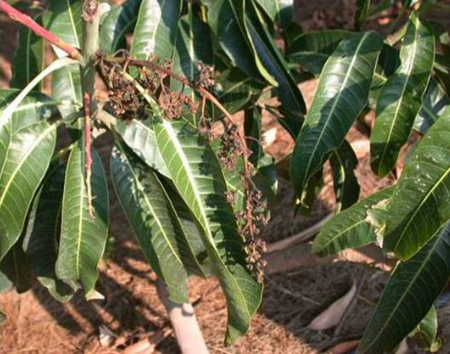
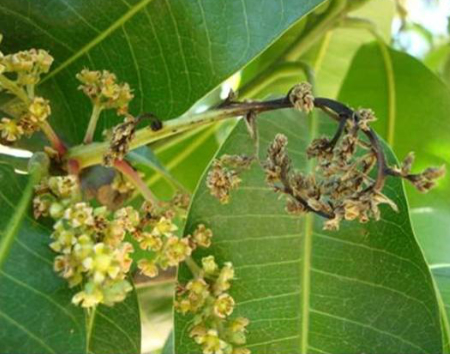
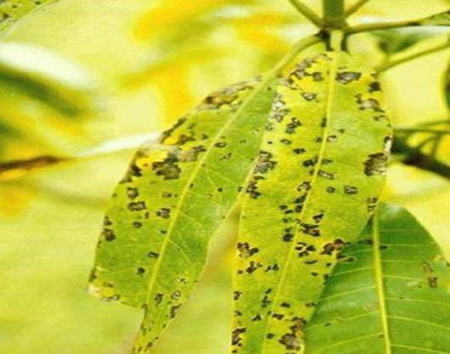
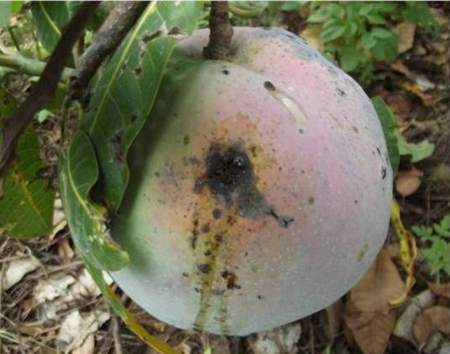
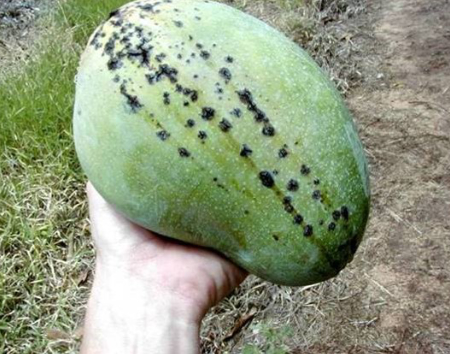
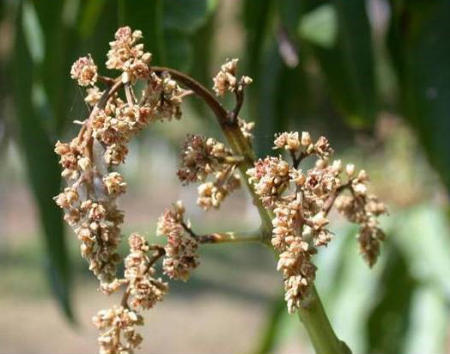
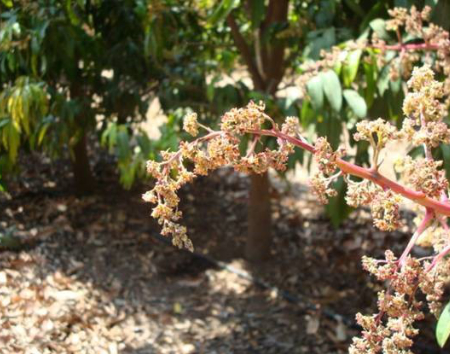
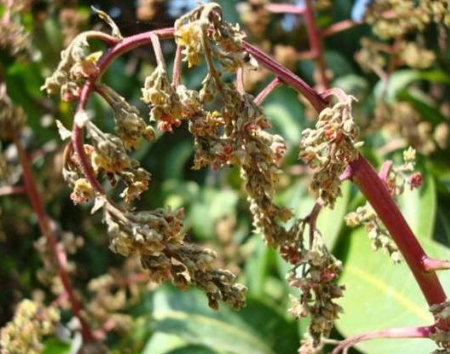
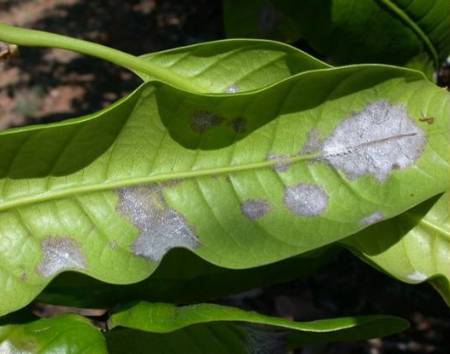
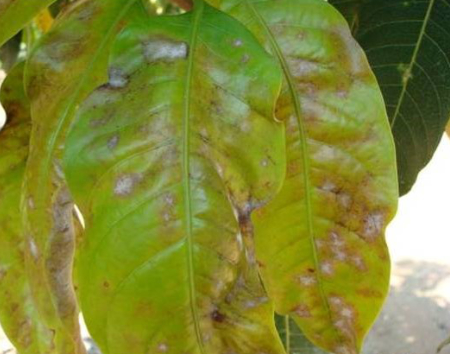
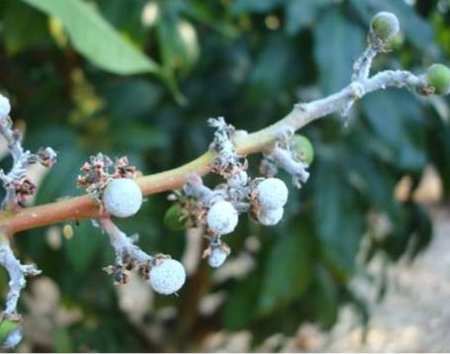
Anthracnose affects all mango cultivars to a varying degree but, since this disease is linked with free water (seasonal rainfall), locality, (high vs. low rainfall areas) and the type of cultivar (early-season harvested before the rainy season vs. late-hanging cultivar hanging through the rainy season), the severity of outbreaks may vary between areas and years. The fungus can penetrate directly into the plant tissue and does not need a wound as does BBS. On inflorescences it begins as small spots that enlarge and coalesce resulting in the death of the affected inflorescences.
“The blacking and death’ of a plant,” caused by Fusicoccum species, starts as a wilt of the affected part of the inflorescence. Large black lesions can also appear lower down the stem. Infection peaks at 100% blossom fall.
Affected flowers take on the appearance of a cauliflower. The axes of the panicles are shorter and thicker than normal. Panicles develop more slowly than normal while retaining their green colour, although the flowers are mostly sterile and no fruit is produced. Malformed flowers stand out when the rest of the tree has already set fruit.
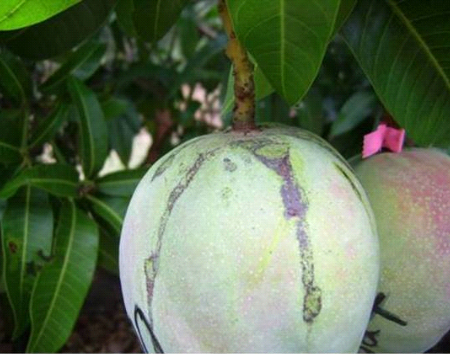
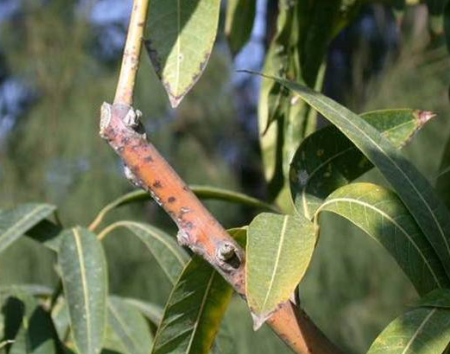
There are differences in susceptibility between the different cultivars. The bacterium does not live long in the soil or in plant residues, but do persist year round in leaf and stem lesions. The bacterium is transferred mechanically through pruning, and naturally through insects and with free water (rain). Infection occurs only through natural openings such as lenticels on fruit and stomata on leaves, or when suitable wounds (wind damage) are present.
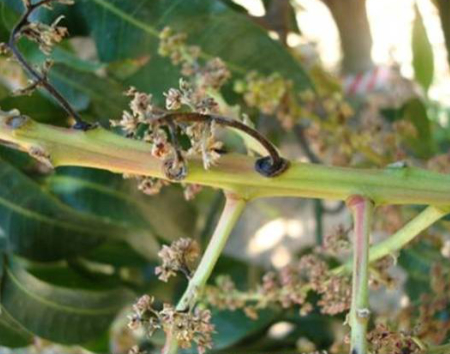
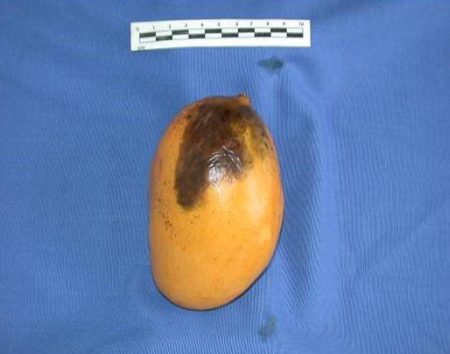
It is generally accepted that infection occurs during the early flowering stage from where it spreads systemically through the inflorescences, where it remains latent until the fruit starts to ripen. The initial stages of SBR can be observed on the inflorescences as blossom blight – ‘the blackening and death’ of the mango inflorescence, usually from a specific point, which spreads and causes the inflorescence to wilt and eventually die, often with a distinct curvature. Also, the stem usually blackens and dies from the tip or growth point downwards, with internal browning forming in advance of external lesions.
Different cultivars exhibiting differences in susceptibility. PM occurs during cool, dry weather (no rain or precipitation), but when humidity is high. This usually coincides with flowering and early fruit set. The disease attacks all plant parts that are rapidly expanding, i.e. foliage, inflorescence and fruit. Infection requires night / day temperatures of 10°C / 25°C and humidity between 60 – 90%. The spores are wind-borne and this results in the rapid spread of the disease under the right environmental conditions. As plant tissue mature, they become less susceptible.
Fruit is most susceptible to sunburn damage, especially during the hottest part of the growing season, and more specifically from the afternoon sun. Sunburn damage of maturing fruit is visually characterised as a bleaching or burning lesion of the fruit skin, especially on the exposed shoulder regions. Sunburn damage of stems and trunks may also occur when the outer cambium layer overheats. Seedling trees are very prone. Tree trunks in the process of being grafted or pruned should also be protected.
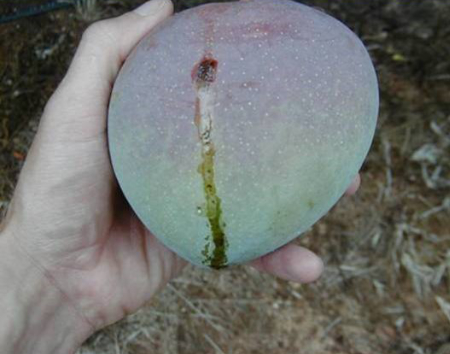
It causes a lot of fruit loss, especially in “Tommy Atkins”. Signs of the disease is grey-brown sunken area on the fruit, and at advanced stages a blackish sunken area develops that splits open. Other signs are a sunken area opposite the suture near the stem attachment. The results in premature ripening of the flesh around the seed and cavity, snap and tear.